
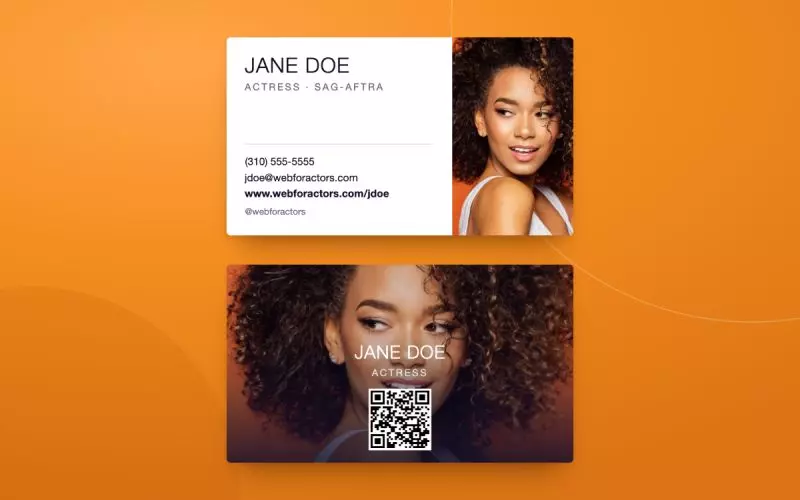
The Business Card Maker builds card art from what is already in your account. Your name, your site address, and your social handles come across without you retyping any of it. That is the whole point of it being connected rather than a blank template.
Which handles it takes
It reads Facebook, Twitter and Instagram from the same place your website reads them: your Links page. Two switches govern each row there, and both have to be on for a handle to appear publicly. One marks the link as active, the other marks it as featured. Your website has always drawn a link only when both are set. Your email signature follows the same rule, and so does the card.
Before that, the card asked for every row you had. A platform you had deliberately switched off in Profile and then Links still went to print. On a website that is a small inconsistency you can fix in a minute. On a card it is five hundred pieces of paper with an account on them you do not use.
Defaults, and the escape hatch
Both switches default to on. If you have never touched them, nothing about your card changes and no handle disappears. This only affects rows you have actively turned off, which is the behavior you wanted when you turned them off.
The three fields on the page are still editable. If you want a handle on the card that is hidden on your site, type it in. The connection to your account is a starting point, not a lock.
What else belongs on it
Less than people put. A card has room for your name, one way to reach you, and your website. Everything else competes with those three. Actors who try to fit their union status, their height, their agent and four social platforms onto a business card end up with something nobody can read at arm's length in a bar.
Your website address is the item that earns its place, because it is the one that leads to everything else. The card does not need to carry your credits when it carries the address of the page that lists them.
Cards and codes
If you are ordering cards anyway, it is worth reading about the QR side of them first, because the two decisions interact. There is also a note on what makes a code actually scan, which matters more than people expect once the card is printed rather than on screen. Referral tracking tells you afterward whether the cards did anything.
The general advice has not changed since we first wrote it: carry them. A card is still the fastest way to hand somebody your website in a room where nobody is going to type a URL. Making sure the card and the website say the same thing is the part worth ten minutes.
Finished reading? Build yours next.
It takes about 76 seconds and it starts free, with your credits, headshots and reels already in it.
Build mine free→